This month has been awesome. I'm what is called board doc which means I run the labor and delivery board making sure everybody has been examined, monitors are placed and all of them are delivered. It's been a blast but it's probably the most crazy experience of my entire life. There is no time for sitting, or eating, or thinking. In honor of board doc, I have re-written the words to a favorite pop song, Tik Tok by Kesha. In medical school we used to have a show Doc Opera with a very similar feel to it, and I used to direct the band. Since there's no Doc Opera in residency, I've spent my few minutes of free time re-crafting the song. So here ya go!
Wake up in the morning feeling oh so S%ty
I got my glasses, I’m out the door, I’m lookin oh so gritty
Before I leave, brush my teeth and I pull my hair back
Cause when I leave for the night, I ain’t coming back
I’m talking danskos on our toes toes
Scrubs instead of clothes, clothes
Blood all over ourselves, selves
Pulling out all the babies
Sewing up all the ladies
Trying to get a little bit messy
Don’t stop, make her pop
Nurse will you run my pit up high
Tonight, push it right
Till that baby sees the light
Tick tock on the clock
But the babies don’t stop, no-oh-oh no-oh-oh-oh
Don’t stop, make her pop
Turn the epidural up to high
Tonight, imma write
Notes til I see the sunlight
Tick tock on the clock
But the pager don’t stop, no-oh oh oh
Ain’t got no sense in the world but got plenty of fear
Ain’t got no food in my belly but nobody cares
Now the tasks are lining up, can I work any faster?
There are 8 million things I’m not sure I can master
I’m talking about everyone running around round
Feet never leave the ground ground
Gonna pit her if she’s moving too slow
Decels so she can’t no second miso-so
Can’t wait until she crowns crowns
Wait until she crowns crowns
Wait until she—
Don’t stop, make her pop
Nurse will you run my pit up high
Tonight, push it right
Till that baby sees the light
Tick tock on the clock
But the babies don’t stop, no-oh-oh no-oh-oh-oh
Don’t stop, make her pop
Turn the epidural up to high
Tonight, imma write
Notes til I see the sunlight
Tick tock on the clock
But the pager don’t stop, no-oh oh oh
I’m cramping up
I might break down
The heart, it pounds
FSE
With my hands in
I got it through
I think we’ll know
IUPC
Let’s build it up
Head come on down
We’re hoping for
Adequacy
With my hand in
With my hand in
Get your hand in
No the party don’t stop when I walk in
Monday, September 20, 2010


Thursday, September 9, 2010
Get On Your Feet

HOLY HOLY! Sorry for that more than brief absence. I am glad I bought comfortable shoes because they are the only thing keeping me standing--along with fear, adrenaline, motivation and a healthy reliance on Diet Dr. Pepper (love this Texan Dr. Pepper phenomenon). The theme of my residency seems to be MOVE! GO! GO! GO! Faster, faster, faster. Don’t breathe, don’t stop, don’t sit down. As one of my senior residents told me, “Don’t tell me you’re going to do it, just do it!”
It’s been incredible. I feel exhausted, but satisfied at the end of the day. I’m learning how to give appropriate, effective care, and the whole environment of frenetic energy is encouraging the more manic side of my personality to emerge. I really hated sitting around in medical school waiting for things to happen, and I’m happy to be working at work. Besides, doing C-sections and deliveries couldn’t be more fun.
Didn’t you know standing at work is good for you? Sure if I keep this up I’ll probably have varicose veins by the age of 30. Even so, I feel energized. A couple of months ago, the New York Times profiled a certain type of desk that is adjustable for people to work standing up. One recent study from Canada showed that in a cohort of 17,013 people, those that spent almost none of their time sitting had a significantly reduced mortality rate compared with those that sat more, even when sedentary subjects participated in vigorous exercise (1).
So, what to eat to keep you on your feet? Well, I don’t get to eat much during the day, but I made some food that is great for any meal of the day be it breakfast, lunch, dinner or a midnight snack. There is nothing quite as delicious as some high fiber, well seasoned black beans and brown rice to give energy and not drag you down.
I know, if I were on Top Chef and I served canned beans I’d probably get sent home, but let’s be honest, I’m not the queen of dried beans and they take forever. This recipe uses black beans and cooks them with veggies and spices, topped off with a little vinegar, fresh cilantro and queso fresco for a vibrant, warm and delicious meal.
Black Beans and Rice
1 medium onion finely chopped
1 carrot finely diced
1 jalepeno finely chopped
2 cloves garlic finely chopped
2 tbsp veggie oil
salt to taste
½ tsp dried marjoram
½ tsp Mexican oregano
2 tsp ground cumin
2 tomatoes diced
2 cans 15 oz black beans drained and rinsed
¼ cup – ½ cup water (depending on how soupy you like your beans)
1 tsp apple cider vinegar
1 tsp (or more for spice) hot sauce
fresh cilantro and queso fresco for garnish

Over medium high heat, preheat the oil in a saucepan. Add the vegetables, salt generously and cook until carrots are soft. Add the spices and cook until aromatic about 30 seconds. Add the tomatoes and cook until begin to release juices. Add beans and water, salt to taste. Turn heat down to medium-low and simmer beans for about 15 minutes until canned taste has disappeared and flavors are melded. Add vinegar and hot sauce. Serve with brown rice and garnished.
Or, just do what I do and shove a string cheese in your mouth when nobody is looking.
1.Katzmarzyk, PT.; Church, TS.; Craig, CL.; Bouchard, C. “Sitting time and mortality from all causes, cardiovascular disease, and cancer.” Medicine & Science in Sports & Exercise, v. 41 issue 5, 2009, p. 998-1005.
Thursday, August 5, 2010
personal SOAP note
A SOAP note, for those not in medicine, is a progress note to assess and evaluate a patient. First, one starts with the subjective, what the patient tells the provider. Objective includes things that the provider notices and provide more information about the physical state including physical exam, vital sign, imaging, and lab reports. Assessment and plan are more straight forward. This is a personal progress note…
S: Feeling well today.
Back aches, relieved by rest.
Infrequent voiding, poor PO intake
Occasional palpitations--worsened by pager, improved by alcohol.
Denies chest pain
No shortness of breath
Ambulating rapidly
O: Vitals:
Pulse 110
BP 120/80
Temp 37
General: alert, questionable orientation to time of day or day of week, smiling and grimacing simultaneously, pressured speech.
Denies suicidal or homicidal ideation—usually. Mood labile
Lungs: Clear
Abdomen: hyperactive bowel sounds
Labs:
Glucose 60
A: 26 y/o G0 s/p day #34 OB/GYN internship initiation.
Patient making questionable progress in her treatment course resulting in exhaustion and occasional idiocy.
Condition improving.
Tachycardia secondary to physical exertion and anxiety.
Hypoglycemia due to poor oral intake
P:
Residency is a condition that can only be cured with time, 4 years on average.
Treatment guidelines include constant focus, increased caloric intake (perhaps a bag of peanuts in the pocket or a granola bar that can be rapidly consumed), increased fluid intake and very comfortable shoes.
Breathing is also advised
Will reassess
Tuesday, August 3, 2010
Cool as a cucumber—refreshing my Spanish on the job

A word to the squeamish or vaginally offended, this post is really about gynecology
I came to Texas for residency because I love taking care of Spanish speaking women. For good reason, I’ve discovered. There couldn’t be a more caring, kind, respectful and fun group of people to take care of than the Mexican and Central American patients that we take care of in clinic and on the wards. Although I have spent multiple months perfecting conversational and party Spanish all over Latin America, my gynecologic castellano wasn’t quite all there when I started residency.
It’s kind of funny to try and communicate clearly but still be professional and culturally sensitive when talking about private parts in another language. Whereas in English I might just come straight out and ask patients about sexual activity, in Spanish, I seem to have better reception and communication if I ask about “relaciones”. While I could literally translate the questions I ask in my history the same way I normally would, I have noticed that in Spanish, phrasing is more modest and more nuanced. So, here below I have a list of common words and phrases used in OB/GYN that I have picked up over the past few weeks.
Basic gynecologic Spanish, patient friendly edition:
Pain—dolor
Blood—sangre
To examine—examinar
My vagina—mi parte (or mi vagina)
Cervix—cuello de matrix (literally neck of the uterus)
Itching—comezón
Discharge—flujo
Pads—toallas
Contractions—contracciones
Cramps—cólicos
Pap smear—Papanicolaou
Speculum—especulo
IUD—dispositivo
Clots—coágulos
D+C—legrado (pretty awesome that there is one short word instead of dilatation and curettage)
Vaginal delivery—parto natural
You probably don’t want to eat after that, but hey, I do it everyday. Even though my patients might be modest about their private lives, they certainly eat some very bold food. The other amazing part about living in Texas besides fantastic patients is the fantastic food, and the large Hispanic grocery stores. Limes are 20 for a dollar and the produce is fresh, diverse and abundant.
One of my favorite Mexican inspired treats couldn’t be easier. It’s a simple dressing put on all fruits, including cucumbers consisting of chile powder, salt and lime. Just makes anything taste better. Keeps me cool as a cucumber!
Mexican cukes
1 cucumber
chili powder
sprinkle salt
juice of 2 limes
Combine and enjoy
Saturday, July 24, 2010
Ginger Ale for the Ailments

Growing up, when I was sick my dad made me drink Gatorade—he was convinced that Gatorade is the nectar of the gods with the perfect balance of carbohydrates and electrolytes to cure any ailment. Most other parents immediately went for, and still go straight to the ginger ale. Ginger ale is pretty much the only drink in the hospital wards as well. Every medical student has probably overdosed on diet Shasta more than once. Even though it is ubiquitous, does ginger actually calm the stomach?
Interestingly, when looking for studies of the effects of ginger on nausea and vomiting, many focus heavily on nausea and vomiting in pregnancy. A review article in Obstetrics and Gynecology in 2005 analyzed four small randomized control trials that showed effectiveness of ginger for reducing nausea and vomiting over placebo [1]. Ginger has also been shown to reduce postoperative nausea and vomiting, although is not as effective in chemotherapy related nausea and vomiting [2,3].
I’ve been working in the OB/GYN emergency room for the past three weeks. I’ve taken care of a fair amount of women with significant nausea and vomiting in their early pregnancy. Usually we give them pretty strong anti-nausea drugs and fluids to help them to feel better. Even though ginger probably doesn’t help for women who have severe enough nausea and vomiting to cause dehydration, it is good to know that ginger can probably help for women with more mild symptoms. The best part about ginger is that is very safe to take in pregnancy, so there is no harm in trying it, and most importantly, it is delicious.
To drown out memories of late night Shasta on call in medical school, I made my own ginger ale. It is based on a very pungent ginger syrup that can be added to club soda, or if you are feeling not nauseous (or pregnant) could use it as a base for a coctail with dark rum or whiskey. Very refreshing!

Ginger ale
2 tbsp fresh ginger grated
1.5 tsp powdered ginger
1 cup sugar
1 cup water
Club soda
Ice (optional)
Lime wedge (optional)
Over medium high heat, bring all ingredients to a boil and allow to cook until syrup is reduced to half and begins to darken. Allow to cool, add about ¼ cup syrup to 1 cup of chilled club soda. Add ice and a squeeze of lime juice.
1. Borrelli F, Capasso R, Aviello G, Pittler MH, Izzo AA. Effectiveness and safety of ginger in the treatment of pregnancy-induced nausea and vomiting. Obstet Gynecol. 2005;105:849–56.
2. Chaiyakunapruk N, Kitikannakorn N, Nathisuwan S, Leeprakobboon K, Leelasettagool C. The efficacy of ginger for the prevention of postoperative nausea and vomiting: a meta-analysis. Am J Obstet Gynecol. 2006;194:95–9.
3. White, B. Ginger: an Overview. American Family Physician. 2007 June 1; 75(11): 1689-1691
Sunday, July 18, 2010
COOKIES!
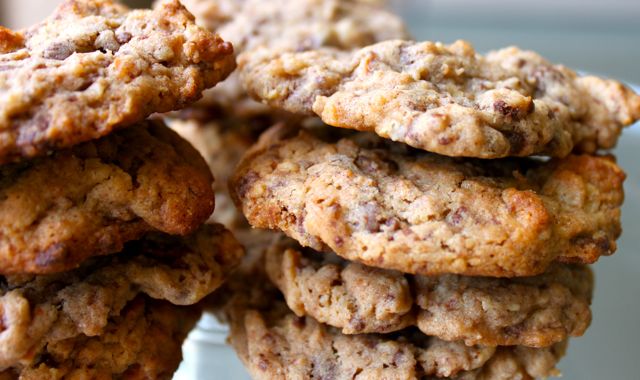
Not much to say this week. Still working, still surviving. The highlight of my week was some delicious, crunchy, sweet, chocolaty, nutty, tangy cookies I stockpiled with unusual ingredients such as malt balls, malt powder, graham flour and pretzels. I brought them to work to seduce the nurses to correct all of my poorly placed orders. Seemingly it worked.
Elizabeth’s slightly unusual but unusually good cookies
½ lb malt balls (such as Whopper’s)
1 to 1 ½ cup sourdough pretzel pieces
¾ cup butter (a stick and a half)
½ cup peanut butter
¾ cup brown sugar
½ cup granulated sugar
2 eggs
1 tsp vanilla
¼ cup malt powder
3/4 cup graham flour (or whole wheat flour)
½ cup oats
1 tsp baking soda
½ tsp salt
1 cup all purpose flour

Preheat oven to 350. In food processor, pulse pretzels and malt balls until bite sized. Alternatively, place in large ziplock bag and pound with rolling pin until bite sized. In medium bowl, combine malt, graham flour, oats, baking soda, salt and flour. Cream butter, peanut butter, and sugars until fluffy with mixer. Add eggs and vanilla, stir to combine. Stir in flour until well combined, then add pretzels and malt balls. Using tablespoons, drop onto ungreased cookie sheets and bake until barely brown (8-9 minutes). Cookies burn on bottom quickly so take em out fast!
Cool and enjoy.
Monday, July 12, 2010
Suturing dinner—herbed ricotta chicken roulades

Still alive! I’m a week and a half into it all. Seems like a lot longer. I feel like I know a whole lot more than I did just a week ago and that each day gets a bit more manageable. Even so, as more straightforward patients seem easier, I am given more responsibility with more complicated patients. I’m learning how to rule out ectopic pregnancies, diagnose all kinds of infections, and how to do endometrial biopsies. I have become the queen of speculum exams; I even found somebody’s cervix in the dark as the exam room had no light besides the overhead lamp.
Along with responsibilities in the hospital on the job, we are required, thankfully, to perfect our surgical skills outside of the operating room. We have a test in September on our knot tying and suturing (a fancy word for sewing). Even though I grew up sewing, I definitely did not do so on a curved needle. When you suture in the operating room, you hold the needle with a tool called a needle driver, which pushes the needle through the tissue. I can do it, but I’m awfully slow.
Along with practicing in our surgical skills lab, I brought home some suture from the hospital to practice at home. What better way to practice sewing flesh than on dinner? Sewing meat simulates the operating environment a lot more accurately than the dry toys that we practice on. Besides, when you make a lovely roulade, it keeps everything together really nicely—much better than interrupted knots.

So for dinner tonight I made herbed ricotta and tomato stuffed chicken breast roulades with a yummy zucchini orzo on the side. The only problem was that the suture was flesh colored and thus was difficult to find in the chicken. I might have swallowed a knot. If you don’t have suture and a needle driver you could use regular needle and thread, or just use toothpicks or kitchen string to tie it up. If you are like me and trying to get better at sewing, this is a delicious way to improve.

Herbed Ricotta and Tomato Chicken Roulades
3 large boneless skinless chicken breasts
½ cup all purpose flour
15 oz reduced fat ricotta
½ tsp fresh rosemary
2 tbsp fresh parsley
2-3 tbsp fresh basil
3 cloves garlic
½ shallot
¼ cup parmesan cheese grated
2 tomatoes thinly sliced
1 tbsp butter
2 tbsp olive oil
~1 cup white wine
2 tbsp balsamic vinegar
Cut chicken breasts in half horizontally and pound down until about 1/8-1/4 inch thick. Dredge in salted and pepper flour. Chop herbs, shallot and garlic finely, mix in with ricotta. Add parmesan, salt, pepper and a splash of olive oil to ricotta mixture. With each breast, spread a thin layer of cheese and a few slices of tomato. Roll up widthwise and sew or tie up. Preheat large skillet or dutch over over medium high heat. Add olive oil and butter and sear chicken breasts for 3-4 minutes. Add white wine to cover breasts about half way up, cover and reduce heat to medium low. Cook until chicken cooked through, about 15 minutes. Remove chicken from pan, add another tsp or so of salt to the sauce, add balsamic vinegar. Turn heat up to medium high and cook sauce until reduced by about 50%. Strain and serve with chicken.

Lemony Zucchini Orzo
½ lb orzo pasta
1 medium sized zucchini, grated
2 cloves garlic finely diced
1 medium shallot finely diced
Juice of one lemon
Splash of white wine
Salt and pepper
¼ cup grated parmesan cheese
Cook orzo in salted water according to instructions. Over medium high heat in about 2 tbsp olive oil, sauté garlic, shallot and zucchini until zucchini cooked through about 5 minutes. Turn heat off, add orzo, white wine, lemon juice, pepper and cheese. Stir to combine and serve.

Subscribe to:
Posts (Atom)